


By Sarah Ann Wu
WordPress is a popular open-source website development tool used by experts and novices alike to build websites, such as blogs, forums, and online stores. In this post, we will review two articles about WordPress. The first is an article about the popularity and features of WordPress by Jordi Cabot, “WordPress: A Content Management System to Democratize Publishing.” The second article, by Elisabetta Adamis, “Styling the self online: semiotic technologization in weblog publishing” looks at how digital platforms, such as WordPress, influence users’ preferences and social constructions of taste.
In his article, Cabot states that WordPress is a multi billion-dollar business and is used for 29 percent of all websites. It leaves its competitors, Joomla, Drupal, Squarespace, and Shopify, in the dust in terms of market share. Though it is opensource, users can opt to purchase themes or plugins, which are developed by members of the WordPress community. While a theme provides the look and feel for a site, plugins extend a website’s functionality. Cabot notes that quality counts when it comes to selecting a plugin and they are often the reason that a website gets hacked. Plugins and themes all go through a review process, but the review criteria can be open to interpretation. WordPress has been working on improving the process for submitting themes and plugins for review, by allowing developers to check their offerings for bugs through an automated process prior to formal submission.
Elisabetta Adamis’ article discusses how digital platforms provide an outlet for self-expression online, but are also subject to semiotic regulation. Adamis states that social constructs affect users’ perceptions of what is good taste and what is aesthetic. WordPress’ open-source customizable templates provide laypeople with opportunities to develop websites without having to learn how to write code, but also provide a framework that affects perceptions of what is desirable. Adamis mentions that WordPress has technological limitations as well as a community of developers who act as hegemonic social forces that ultimately influence what designs and color palettes have to choose from:
(Adami, 2018, p, 602-603)“Findings show the role of a semiotic technology, such as the WordPress platform, in mediating between different layers of sign-makers; its mediation conceals the agents behind the technological affordances, naturalising the power relations (and related conflicting views and positions) that concur to the production of semiotic regimes. This produces an objectification/technologization of the social values associated to patterned uses of semiotic resources (e.g. “professional” is objectively/always desirable; a certain colour palette, layout and font combination is “professional”), generating consent towards hegemonic semiotic regimes and self-regulation in individual expressions of identity.”
In her article, Adami provides a list of searchable style descriptions that highlight the more desirable styles search terms.
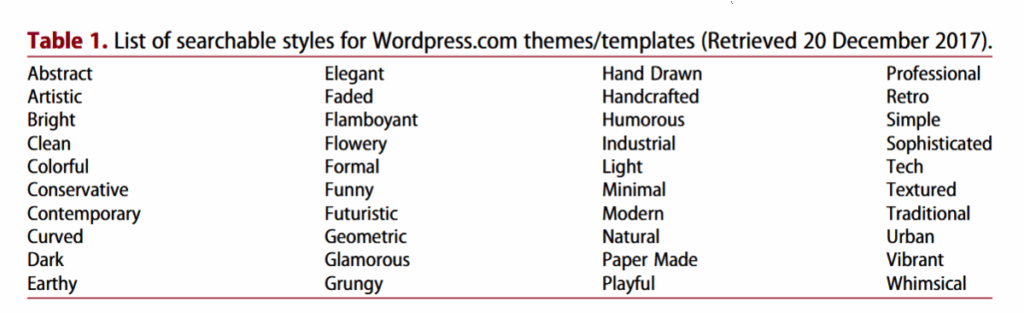
I found both articles interesting to read. For example, reading Cabot’s article about the history and structure of WordPress provided insights into how the opensource community has become so large and profitable. I also found Adamis’ viewpoints very insightful, because I do believe that the technology we use shapes us, just as we shape the technology we use. I agreed with Adamis’ idea that style, such as presenting oneself in a stylish way, has replaced the definition of professionalism, which used to be dependent on one’s expertise. I think style is important when it comes to a website, because it is your marketing and shape’s perceptions of your brand. The look and feel of websites is constantly evolving, and what is in vogue today likely won’t be in a few years.
Works cited:
- Cabot, J. (2018). WordPress: A content management system to democratize publishing. IEEE Software, 35(3), 89–92. https://doi.org/10.1109/ms.2018.2141016
- Adami, E. (2018). Styling the self online: semiotic technologization in weblog publishing. Social Semiotics, 28(5), 601–622. https://doi.org/10.1080/10350330.2018.1504713
For those of you who are new to WordPress, the video below offers a very helpful introduction that will help you with the basics of setting up a WordPress site.